Friday, 28 November 2008

To Be Delightful

I think we have a lot to learn from the old girls. I don't mean the quite old girls, like myself, I mean the really old girls - i.e., you're barely in this club aged 80, sister!

I've been thinking about them ever since I met my friend Margaret's new step-girlfriend. That's what she calls her, because she is the new girlfriend of her late mother's boyfriend....Still with me? To explain: Margaret's late mother had a boyfriend, Peter. Sadly, Margaret's mother died a couple of years ago and Peter now has a new babe, the Step-Girlfriend. And as he had become a big part of my friend's family when he was dating their mother, Pete's new octogenarian arm candy has been enthusiastically welcomed, too, although she is no relation by either blood or marriage. But, my goodness, she is fabulous!

It's not just the size-8 figure, the defined waist, or the way she walks as though she were about to break into a quickstep at any moment. It's not even her perfectly kept nails or her beautifully set silver-white hair. No, that's all good but it's not the heart of it.

Of course, her clothes help. She's always immaculate in a cashmere twin-set and pearls for casual day wear, a suit for smart days and a selection of lovely, below-the-knee, waisted dresses for dinner or cocktails. I'm told that it's proper long gowns if there's a chance of a dance at an evening event. She never wears trousers, and always wears heels. But while she's very well turned out, there's more to her appeal than grooming.

The really amazing thing is that the Step-Girlfriend is not the only one I know of this marvellous breed. Two more immediately spring to mind, both mothers of good friends, in their 90's and a delight to behold and spend time with. And that, I think, is the crux of the charm of these golden girls.

They aim, at all times, to be delightful.

They always look interested in what you're saying, even if you rather suspect they can't quite hear you.

I do understand that this could be perceived as a hangover from the 1950's man-pleasing mode, when women were expected to adopt a perfect-wife persona, hiding their real needs and feelings under a wipe-clean, easy-care veneer of feminine charm. That would be terribly depressing, and I really don't think it is what I am seeing in these luminous ladies.

Rather it is a refined form of self-discipline, always to put on a delighted and delightful demeanour, whatever you're really going through inside, as a courtesy to others.

In our age of let-it-all-hang-out, where people exert no self-control when it comes to venting about whatever is getting them down at any given moment - regardless of the effect their mood may have on others - it really is a pleasant change.

And I don't excuse myself from that criticism. I'm a shocker for letting whatever I'm feeling - be it frustration with a slow supermarket queue, or a genuine concern - play across my face like a Reuters screen. Not nice.

So, while I'm all in favour of being real about my feelings in the appropriate context, I think there's a lot to be learned from these shining members of an older generation.

I would very much like to learn how to be delightful!

Sculpture by the Sea, Bondi, 2007 - Two very delightful sculptures.

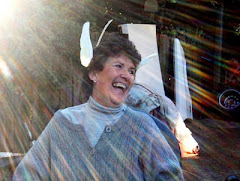
My 86 year old mother - Beryl, myself and my 96 year old Aunt Mary. Two very delightful women.

Wednesday, 26 November 2008

Let Us Be Thankful

With an open heart I wish you all a happy Thanksgiving.
I envision an evolving world where peace and love prevail.


The information below gives a brief history of Thanksgiving which will be of interest to those like myself not from the USA.

In 1621, after a hard and devastating first year in the New World the Pilgrim's fall harvest was very successful and plentiful. There was corn, fruits, vegetables, along with fish which was packed in salt, and meat that was smoke cured over fires. They found they had enough food to put away for the winter.

The Pilgrims had beaten the odds. They built homes in the wilderness, they raised enough crops to keep them alive during the long coming winter, and they were at peace with their Indian neighbors. Their Governor, William Bradford, proclaimed a day of thanksgiving that was to be shared by all the colonists and the neighboring Native American Indians.

The custom of an annually celebrated Thanksgiving, held after the harvest, continued through the years. During the American Revolution (late 1770's) a day of national thanksgiving was suggested by the Continental Congress.

In 1817 New York State adopted Thanksgiving Day as an annual custom. By the middle of the 19th century many other states also celebrated a Thanksgiving Day. In 1863 President Abraham Lincoln appointed a national day of thanksgiving. Since then each president has issued a Thanksgiving Day proclamation, usually designating the fourth Thursday of each November as the holiday.

Sunday, 23 November 2008

A Different Perspective

I am a great fan and admirer of Cirque Du Soleil and over the years have been very fortunate to see a number of their absolutely sensational shows.

At each of these shows, I have joined thousands of other people in the circus tent to reflect in total awe on the amazing and seemingly impossible acrobatic feats in each performance. When this is coupled with the larger than life sense of theatre that engulfs everyone, it leaves you inspired and full of appreciation for what you have just seen.

Just recently I had the opportunity to see the same Cirque Du Soleil show for a second time within a space of about a month. At the first show, my friend and I were seated about thirty rows back from the stage, so you could imagine it was not easy to see all the expressions on the faces of the performers or for us to fully appreciate the passionate effort that they put into their individual performances. However, what we were able to enjoy was the wonderful panorama of the overall performance.

At the second show, we were fortunate to be seated in the second row just a couple of metres from the stage and we could now see close up the performers and their expressions. Equally, having seen the show before, we both looked forward to seeing our favourite segments for the second time.

Driving home after the second show, we talked about which of the two shows we enjoyed the most and also whether it was better to sit close to the stage or further back. We agreed that both shows were equal in terms of their spectacle and enjoyment, but from two totally different perspectives. In seeing the show for the second time, our appreciation of the absolute brilliance of Cirque Du Soleil was significantly enhanced and without doubt will always be remembered.

In the days that followed it occurred to me that there are some parallels between the experience we had at the two Cirque Du Soleil shows and what happens in our every day lives when we deal with the many challenges that face us.

How often do we make a decision about something important to us based on one single viewing of the facts or act just on what are our first impressions of the situation, without taking the time to gain a better feel for things. By way of example, when we read a good book or watch a movie for the first time it is so easy to believe that we now have a full understanding of all that we have just read or seen. Then at some later point, if we read the book or watched the movie for a second time we are almost certain to discover lots of other important things that we missed the first time around.

Whilst we often don’t have the opportunity to consider an important challenge or situation for a second time before we make a decision about the course action we will take, we should always endeavour to make time to stand back and view things from afar in order to gain a perspective of the bigger picture, and then be able to revisit the challenge or situation close up to see the finer detail and further improve our understanding.

In the light of the different perspective that a second viewing can provide to us, we would then be in a better position to make a more balanced and considered decision about the action we should take. I am sure if we all strived to do this, the outcome may very well be as enjoyable and uplifting as my second visit to Cirque Du Soleil.


Sculpture by the Sea, Bondi, November 2008 - These two photos are an example of a different perspective of the same sculpture, one from afar and one up close.


Wednesday, 19 November 2008

A Sacred Bond

“Some people go to priests; others to poetry; I to my friends.” These words of Virginia Woolf are a pointing reminder of the importance of friendship in our lives.

I spent the afternoon with my 'best friend' from my high school days. We hadn't seen each other since 2002, but it seemed like only yesterday.
There were no awkward moments, just laughter and filling in the gaps of those years, with the sad events and the happy ones.

When we think of our friends we immediately think of those people who have been constantly present in our lives, those who have been a stellar support to us in happy times and times of crisis. Perhaps it is not always easy to define friendship. It isn’t built on a list of expectations as is the case with other relationships. But then perhaps it is this freedom, this unspoken tenderness, this amalgamation of faith, trust, support and other beautiful aspects that make it such a sacred bond.

Any person who has ever enjoyed a wonderful bond of friendship will understand the importance of being there for the friend. Life is a continuous learning experience and along the way every person encounters happy moments and trying times. What one needs during the happy times as well as the painful ones is constant support and a true friend knows this only too well. Sometimes it is not always possible to be there for your friend in person but modern technology has allowed people to connect in spite of geographical distances.

Perhaps it is only in friendship that people are capable of giving unconditional acceptance and love to another individual and this is the hallmark of true friendship. It means friends allow each other to be human and commit mistakes and learn from the mistakes. It also means that friends love each other in spite of the mistakes. This acceptance and love also means that friends talk to each other if they have any issues between them and that they treat each other with respect, dignity and kindness. They also give each other the benefit of doubt and try to understand the other person’s perspective.

True friendship also means that our friends encourage us to reach and perform according to our potential and do not transgress our boundaries. In a healthy friendship bond you should never be forced by any of your friends to do anything that you are not comfortable doing. There is genuine concern for the emotional, physical and spiritual well being of each other in this beautiful relationship.

Some of my favourite Friendship quotes.

“Friendship is the inexpressible comfort of feeling safe with a person, having neither to weigh thoughts nor measure words."
- George Elliot

"Friendship with oneself is all-important because without it one cannot be friends with anyone else in the world."
- Eleanor Roosevelt

"Grief can take care of itself, but to get the full value of joy you must have somebody to divide it with."
- Mark Twain

"With every friend I love who has been taken into the brown bosom of the earth a part of me has been buried there; but their contribution to my being of happiness, strength and understanding remains to sustain me in an altered world."
- Helen Keller

"What is a friend? A single soul in two bodies."
- Aristotle

"In the end, we will remember not the words of our enemies, but the silence of our friends."
- Martin Luther King Jr.

Carole King, Celine Dion, Gloria Estefan & Shania Twain - You've Got A Friend

Monday, 17 November 2008

Who Are You?

Caroline over at The Zen in You has been writing some very insightful posts (she is a fellow Sagittarian so I expect nothing less...) and the one on 'Confronting Fears' reminded me of a story that was read to us in Philosophy a couple of months ago.

In a remote mountain village the head of the village died and leadership was passed on to his son.

Now the people had lived many years under the control of a huge monster who loomed like a shadow over the village.

Whenever anyone tried to find freedom this large shadow appeared with a loud voice echoing through the mountain. The villagers always retreated at the sight of the dark image.

The young man who was now the leader realised the time had come to confront this monster. He went out with a group of villagers and as soon as they appeared at the edge of the village the huge shadow appeared. They stepped back in fright.

The young man observed how the shadow became bigger and the voice louder as they retreated. He paused and then bravely took a step towards the shadow. It seemed to become slightly smaller. He stepped again and his view was confirmed, the shadow became less and the voice less powerful.

He continued moving towards it until at his feet was the source of the shadow. He plucked up this small ephemeral object in his had and asked

"Who are you?"

Fear was the weak feeble reply.

He closed his hand and it disappeared entirely.


The moral of the story was to 'Observe Fear and let it pass through you'.

Manly, Sydney, June 2008 - BEFORE


Manly, Sydney, June 2008 - AFTER